
The Readable Faulkner
He even wrote murder mysteries

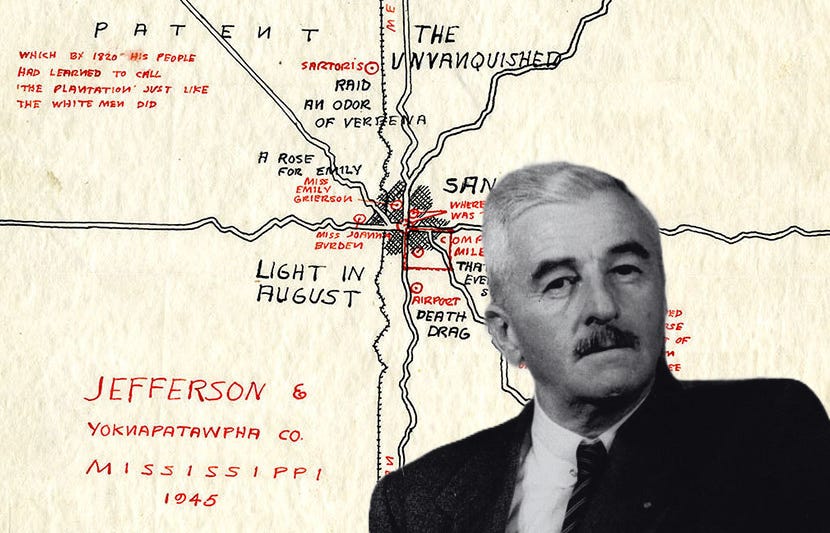
Everybody who has gotten past high school in America has at least heard of William Faulkner, maybe already read some of his work. Some have looked at works like Absalom, Absalom!; A Fable; and Requiem for a Nun, then turned away. High school and college reading requirements sometimes leave bad impressions, but there’s good news about Faulkner. A large number of his books are very readable and entertaining to boot. If you gave up on Faulkner, maybe a second look at the right stories will change your mind.
While Hemingway wrote as a master of minimalism, just enough words and no more, Faulkner tended to go the other direction. If a little bit is good, then a whole lot is better. He wrote some purple prose, and that doesn’t work for all readers. I suspect this is likely the biggest reason why some avoid Faulkner. I’ve picked up a few of his books, because I heard they were masterworks of the art, tried reading, then quit because the text just didn’t work for me. For example, Alsalom, Absolom! opens like this:
From a little after two oclock until almost sundown of the long still hot weary dead September afternoon they sat in what Miss Coldfield still called the office because her father had called it that—a dim hot airless room with the blinds all closed and fastened for forty-three summers because when she was a girl someone had believed that light and moving air carried heat and that dark was always cooler, and which (as the sun shone fuller and fuller on that side of the house) became latticed with yellow slashes full of dust motes which Quentin thought of as being flecks of the dead old dried paint itself blown inward from the scaling blinds as wind might have blown them. There was a wistaria vine blooming for the second time that summer on a wooden trellis before one window, into which sparrows came now and then in random gusts, making a dry vivid dusty sound before going away: and opposite Quentin, Miss Coldfield in the eternal black which she had worn for forty-three years now, whether for sister, father, or nothusband none knew, sitting so bolt upright in the straight hard chair that was so tall for her that her legs hung straight and rigid as if she had iron shinbones and ankles, clear of the floor with that air of impotent and static rage like children’s feet, and talking in that grim haggard amazed voice until at last listening would renege and hearing-sense self-confound and the long-dead object of her impotent yet indomitable frustration would appear, as though by outraged recapitulation evoked, quiet inattentive and harmless, out of the biding and dreamy and victorious dust.
A paragraph long sentence, actually two sentences in there, and the opening pages contain many more paragraphs just like this. Sorry, my brain cannot process it, and my interest in the story withers away. Faulkner failed to hook me here. On the other hand, other readers love this novel, and I’m happy for them that they found something enjoyable. Literate fiction has something for everyone. People who loved James Joyce’s writing like Ulysses and Dubliners would likely enjoy this kind of Faulkner. I’d guess they’re no fans of Mickey Spillane, and that’s fine.
While the artful, dense, hard-to-read books may have helped Faulkner win the Nobel and a couple of Pulitzers, the easier-to-read works, plus a heap of screenwriting in Hollywood brought him much-needed money. Faulkner was a soft touch who had already taken in his dead brother’s family and didn’t say “No” to family and friends in need. My guess is that he wrote these other titles, because they would sell, and he needed the money to support his relatives. Why else would Faulkner leave his beloved Oxford in the 30s and 40s to work in Hollywood at MGM and Warner Brothers? The upside is the dialog he wrote in the screenplays adapting Hemingway’s To Have and Have Not, Chandler’s The Big Sleep, and his own works: Sanctuary as The Story of Temple Drake, and Pylon into The Tarnished Angels.
The good news is that besides purple prose, Faulkner wrote a number of novels and stories that are very readable and display his talent for storytelling. For those who shied away and avoided Faulkner, I’d like to introduce a few titles I have read and remember as not-purple-prose and well plotted. There’s likely more. All are literary fiction, nothing dumbed down, and many are Southern Gothic. After reading and enjoying bushels of noir and hard-boiled crime, the violence in Southern Gothic doesn’t faze me.
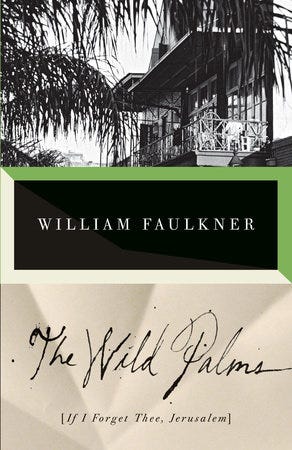
One good place to jump in is his 1939 novel, The Wild Palms, also known as If I forget Thee, Jerusalem in more recent releases. This novel is literary fiction with two plots: in 1937 New Orleans, Harry, a young intern finishing up his training, runs off with Charlotte, who abandons her husband and two children. The couple drifts across the Midwest and mountain west, before venturing back to Mississippi. The novel’s second plot is 1927 Mississippi and the historic flood of that year. A prison convict is put to work, and he rescues a very pregnant woman from her roof, bringing them to safety, where she gives birth on a hillock. The chapters alternate between the two plots, the characters are fascinating, and the novel reads easily. Lots more good details, but I don’t want to spoil anything in this well-crafted book, beyond noting that there is a dead mule in the story, a required element in Southern fiction.
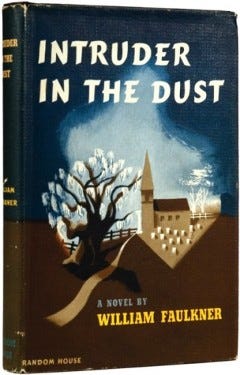
Mystery and crime fans should consider Faulkner’s 1948 novel Intruder in the Dust and the 1949 story collection Knight’s Gambit. Intruder is a straight up murder mystery set in Mississippi. A black farmer, Lucas Beauchamp is accused of murdering Vincent Gowrie, a white man. On the way to jail, Lucas asks teenager Chick Mallison for help. Chick knows Lucas to be a good man, and through Chick and his friends’ efforts, along with spinster Miss Eunice, they solve the puzzle of who shot Vincent Gowrie dead. Classic mystery puzzle piece with clues and red herrings. Not hard-boiled, but certainly not cozy with touching on race relations and grudges going back to the Civil War.
Still more crime and mysteries are in the 1949 story collection Knight’s Gambit. In here the protagonist is prosecuting attorney Gavin Stevens, who also appeared in Intruders in the Dust. This collection of six stories with the title story running about novella size are genuine mysteries, where Stevens takes part in investigating crime in Faulkner’s Yoknapatawpha County, leveraging his knowledge of the people there as well as human foibles to build cases and put the real criminals away. These stories were initially published in magazines from 1932 to 1949, then collected in a single volume, and together can be read like a novel. In 1972 Joseph Anthony directed the film adaptation. Tomorrow, starring Robert Duvall and Olga Bellin, the script adapted by Horton Foote. Yes, Faulkner could right a good murder mystery.
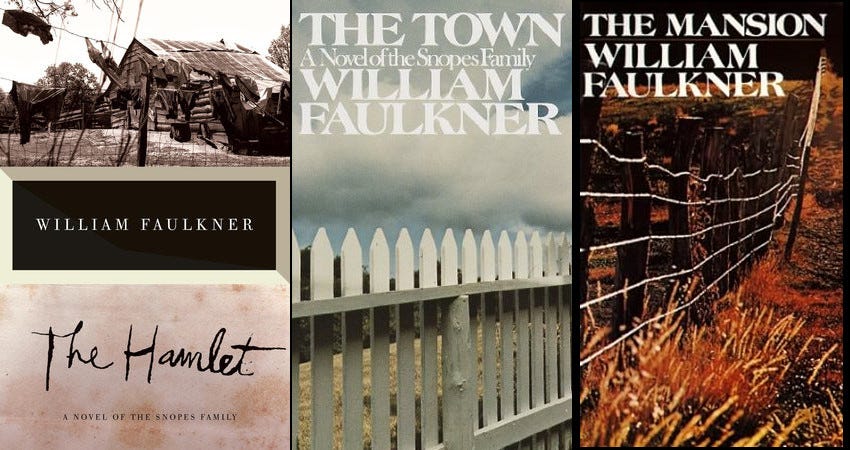
The Snopes Trilogy: The Hamlet (1940), The Town (1957), and The Mansion (1959) are classics not overly burdened with acres of purple prose. These three novels form the saga of the Snopes clan in Faulkner’s Yoknapatawpha County, beginning in the 1840s and moving through to the twentieth century. One strength in these novels is how Faulkner chronicles the history of a family settling into a place, then leaving its mark on both the land and the people. Common for Southern writing, the setting is just as much a character as the people, and the Snopes family are people you will not soon forget. Read and see for yourself.
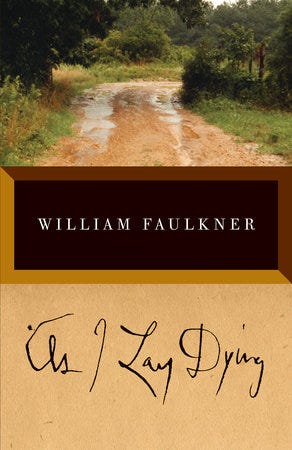
As I Lay Dying (1930) is easy reading, even if the topic and many of the events in the story are not pleasant. I’ve gone back to read this one again at least twice. A distinction of this novel is that it’s narrated in the first person by fifteen different characters across fifty-nine chapters. Faulkner masterfully captures the personality of each character and gets the voice on the page, all of them dirt-poor whites in the back country of Yoknapatawpha County, Mississippi. The story opens with Addie Bundren deathly sick and not long for this world. She hears her eldest son, Cash sawing and hammering the lumber for her coffin. After she passes, the family loads her in the coffin and into a wagon for the long trek to her home town of Jefferson to bury her among her kin. The journey takes nine days and is a macabre comedy of everything going wrong that could possibly go wrong. The novel uses stream of consciousness in a good way in places, easy to read, and I think this comes from writing in character for each chapter. If you gave up on Faulkner, give this one a look.
If you like James Ellroy’s hard-boiled crime stories like his LA Trilogy of LA Confidential, The Big Nowhere, and the Black Dahlia, then Faulkner’s Sanctuary will work for you. Published in 1931, it’s the tale of the abduction and rape of an upper middle class Ole Miss college student Temple Drake. The story is populated by shady characters like bootlegger Lee Goodwin and his sidekick Popeye. These guys and their friends are the Yoknapatawpha County, Mississippi equivalents to the miscreants Ellroy wrote about, and this novel shows how much Southern Gothic can resemble hard-boiled crime. Don’t read any of this to your kids for bedtime stories. Instead, pour yourself a bourbon or similar adult beverage and put some Coletrane or Miles Davis on the stereo while reading this one.
I was still in high school in the 70s when I first read the collection, Go Down, Moses from 1942. It must have been a school assignment, and I still have the paperback. These stories are a good illustration of Faulkner’s Yoknapatawpha County and the characters who live there. I remember liking the story, “The Bear” a lot, and I re-read the collection about a year ago. A number of the stories feature the McCaslin family and its members, some more eccentric than others. A couple of the stories venture into purple prose, but most feature action from unhinged and slightly crazy Uncle Buck and Uncle Buddy McCaslin going after some enterprise or another: bootlegging, poaching, tracking down runaway slaves. This collection has a whole lot more going for it than what first meets the eye, because it also deals with two branches of the McCaslin family: one white, and one black with the slaves on the plantation. This is something unique to the South, the mixing of slaves and slaveholders in family relations. A number of authors addressed this, and it’s worth an article by itself.
Overall, Faulkner wrote a sizable amount of short fiction, and Go Down, Moses is just one collection out of many. Modern Library also published a collection, and no doubt there’s more. “A Rose for Emily” is a classic Southern Gothic tale that sill has impact some ninety years after first publication. You’ll also find Snopes and McCaslins in other short stories like “Barn Burning.” For those completely new to Faulkner, this may be the best place to start with small doses. If an individual short story doesn’t work, skip to the next one. You’ll find some keepers.
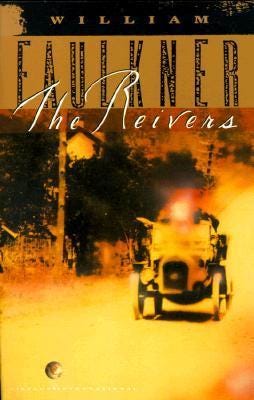
Faulkner was pretty good at writing funny as well. His last novel, The Reivers in 1962 won the 1963 Pulitzer, and as swan songs go, this one was pretty good with Faulkner going out on a high note. In this story, we have a straightforward narration of how eleven-year-old Lucius Priest, a McCaslin, gets entangled in a road trip to Memphis in a stolen car, stopping at and boarding in a Memphis brothel. The whole story is a picaresque comedy, uncharacteristically lighthearted given the subject matter. Young boys are not supposed to be involved with Grand Theft Auto and Memphis whorehouses. Nonetheless, this is a humorous adventure story, and Faulkner pulls it off well. Trust me, this is a good read, even if the academics dismissed it.
There’s a lot of Faulkner out there that is easy to read. You might have to pick and choose, but it’s worth the effort. The man earned his Nobel Prize in literature, and that comes clear after reading him. If you like Southern writing, then Faulkner is your guy, tried and true. But even if you don’t, there’s plenty that ought to scratch your itch for a good story told well. Give Faulkner a second chance and see.
Much of his work is now public domain in Canada, and the Canadian site Faded Page has eBook copies for Canadians to download at https://www.fadedpage.com/csearch.php?author=Faulkner,%20William
For more articles on authors, try. . .
Thanks for the reminder that he wrote some humorous, gripping stories, too. As I Lay Dying still feels as clever and inventive today as it was in 1930. I reread it every few years.
Faulkner is completely unknown to me, infact apart from having heard his name in some circumstance I can't relate to him or his work. But then again I didn't attend High school in the US. So I am unbiased and curious. Thank you for something new.