
Sunday Visitor
A hippie comes to church, and what will we do? A short story and the opening chapter to CROSSING THATCHER'S CREEK.

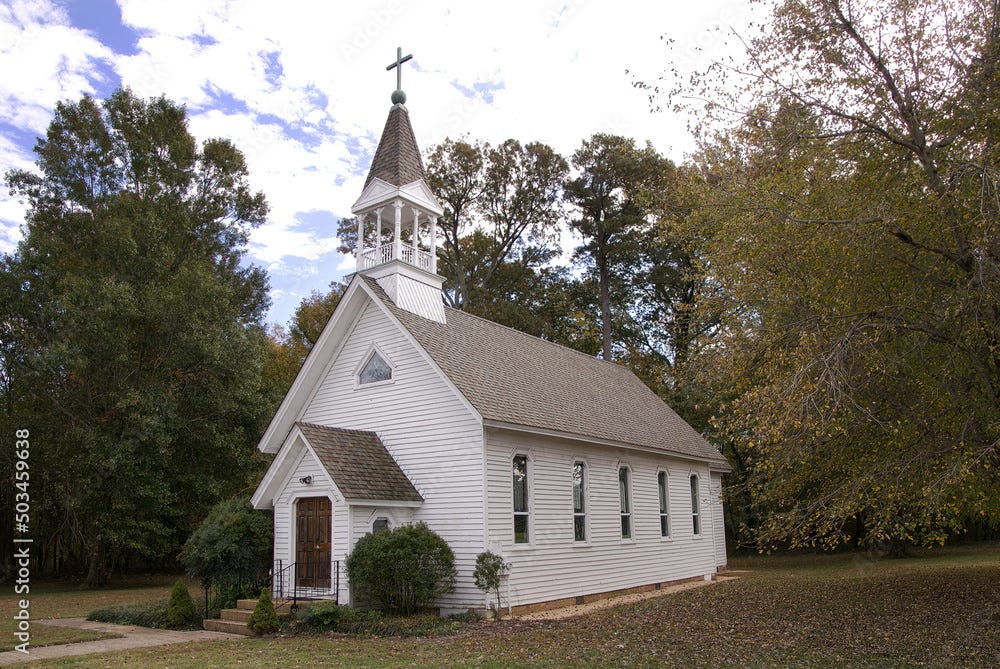
Lester dropped half his stack of bulletins when the hippie walked past him and ambled down the aisle. The town of Guilford saw its only hippies escorted out of the county some twenty-five years ago, their garish van flanked by two cruisers and a motorcycle patrolman just to make sure they made it to the other side of the bridge over Thatcher’s Creek, where they could become somebody else’s problem.
Even during the craziest of those years, no hippie had ever dared to step inside the orderly confines of the First Presbyterian Church. Not that it wasn’t a friendly place, but like the rest of Guilford and surrounding Chesterton County, Virginia, the grounds held a sense of rural decorum and dignity. Granted, half the congregation spent their weekdays in bib overalls, cultivating soybeans and tobacco, but they always dressed formal for church. Wasn’t that why folks called it their Sunday Best?
The hippie paused in the middle of the sanctuary to admire the stained glass windows and the skylight. Homer Clanson and Buddy Reed installed the skylight when they reshingled the roof eighteen years ago in 1979 and found rotted lumber. They had put their heads together decided the church was due for a little improvement. Since they needed to replace the planks and a beam anyway, why not add a skylight? The old-timers naturally griped at first but soon enough took to liking it. The yellow glass overhead lit up the white pews with a golden glow like Easter morning, even on overcast days.
The sanctuary stood mostly empty because Sunday school hadn’t let out yet, and Lester touched his fingers to his lips, trying to decide what he was supposed to do. After all, he had just been elected deacon and head usher. On the other hand, this wasn’t the kind of thing the usher’s handbook covered. He knew how to turn off the fire alarm and where to find the fusebox. He could even point the way to the fallout shelter in the fellowship hall downstairs, but nobody had thought about hippies back in 1953 when Buck Smithers and Ron Clanson, Homer’s daddy, had written the usher's guidelines.
Lester bit his lip, trying to think of what he should do. This looked a lot more serious than running out of seats for Christmas Eve candlelight service. Hippies in the church – what was the world coming to? He looked out the double door and saw Eddie MacPhearson, Eddie Mac to everybody but his parents who still called him Edwin. He knew how to handle situations from long experience. Eddie Mac was a church elder and knew what to do. Lester leaned out and waved at him. “Eddie Mac, come here.”
“I quit smoking. Get somebody else to light the candles.” Eddie Mac didn’t seem impressed by the urgency in Lester’s voice.
“No, not that.” Lester looked over his shoulder to make sure the hippie hadn’t done anything like spray paint peace signs on the pews or roll marijuana cigarettes on the communion table. “I got a situation.” His eyes grew large and his mouth hung open while his left hand waved a stack of bulletins as if shooing flies.
Eddie Mac’s forehead wrinkled the way it did when he talked about his son coming home from college with an earring in his left ear, and how he couldn’t think of any reason why his boy would do a damnfool thing thing like that. He gripped the wrought iron rail and mounted the stairs. Eddie Mac was here the Sunday that Widow Paxson passed away in the front pew. Folks thought she had just dozed off again in the middle of the sermon, but when she tipped to the right and her head plopped into Helen Clark’s lap, things looked a little bit odd. Of course Helen, her best friend, lifted her upright and propped her against the side of the pew, waiting until services were over before asking Dr Nelson to come over: “She looks just a mite dead.”
Eddie Mac was ushering that day, and with a hand from Dr Nelson and Buck Smithers, they laid Widow Paxson’s body out on the front pew – her favorite spot for forty-eight years – then covered her nice with a tablecloth while they waited for the sheriff to arrive with the boys from the county hospital. Whatever was bothering Lester now, it couldn’t be worse than figuring out what to do with the dead body of a ninety-one year old woman in the front pew.
Lester took Eddie Mac’s arm and towed him inside. He stopped in the narthex at the open doors to the sanctuary and extended a hand to point out the hippie, who now sat cross-legged on the floor in front of the first pews and leafed through a hymnal.
Eddie Mac stroked his chin and watched the hippie. As hippies went, this one wasn’t too nasty. The bearded young man’s hair looked reasonably clean, not too much longer than some of the young folks in Guilford, although the tips of it had a shade of blond not found in nature. Whoever did the hippie’s hair was probably the same one who tattooed his wrists to make them look like ivy was growing on them. At least this hippie wasn’t wearing a ring in his ear, instead he had one pierced through his left nostril and a stud through his right eyebrow. Eddie Mac felt thankful that his boy wore only a single earring.
The hippie carried a frayed green nylon rucksack over a red and white plaid flannel shirt, untucked, and he had jeans on. Everybody wore jeans these days, but not to church, not in Guilford, and never at First Presbyterian. Even the Methodists across town didn’t wear jeans in the sanctuary. Chesterton County and its people had always stood outside the turmoil of the culture wars. They never saw a beatnik, only had a few run-ins with hippies in the ‘60s and ‘70s, and were too rural for the yuppies of the ‘80s. So far, the '90s had been kind to Guilford, but that could change at any moment. Eddie Mac glanced at Lester, squinting as the wheels turned inside his head. It might be twenty or thirty years too late for Guilford to be seeing hippies, but Eddie Mac was old enough to remember hobos. Big cities had problems for years with homeless people, and maybe now it had begun to reach out to Guilford. He wagged a finger. “You’re right. We got a situation.” As proprietor of Chesterton County’s sole Allstate Insurance agency, Eddie Mac’s opinions always carried great weight.
Lester wrung his hands. “What do we do?”
People began filtering into the nave from downstairs with Sunday school letting out. Eddie Mac took a stack of bulletins and began handing them out as members filed in. Ida Mae Crawford smiled a good morning to Lester as she took a bulletin, then stopped as if she had run into a glass wall a half step into the aisle. She turned to Lester and Eddie Mac. “Is that?”
“Yes’m.” Eddie Mac leveled his eyes on her, voice as flat as a city cop’s. “Looks like a hippie.”
She turned to Lester for confirmation.
“I saw him first.” Lester nodded.
“We got it under control.” Eddie Mac’s low voice carried a tone of authority.
“A hippie?” She wrinkled her nose the way she did when the wind shifted her way during fertilizing season. “In church?”
“Don’t you worry, ma’am. We’ll take care of it.” Eddie Mac made a small smile. He was Allstate’s good hands in Guilford.
“Where’s Roy?” Lester asked.
Ida Mae frowned. “Parking the car.”
“Is there a game on the radio?” Eddie Mac asked.
Ida Mae nodded. “Same as last week.” She set her jaw. “Took him two hours to find a parking space, he said.”
“Lester.” Eddie Mac hooked a thumb at the doors. “Go fetch him.”
Lester nodded and left.
Eddie Mac handed out bulletins and reassured members that the situation was under control. Yes, ma’am, that’s a hippie sitting on the floor. Nosir, he’ll be no trouble at all; we’ll make sure of that.
Roy Crawford quick stepped into the narthex, gaze darting around as if he were missing something important. Lester tagged along at his heels and pointed out the hippie.
Roy’s eyes widened and he reached up to straighten his tie. Sundays were the only day he wore one, and most folks figured he left it tied and slung over the back of a chair during the week. “I’ll be damned.” He strained to keep his voice low.
“Roy.” Ida Mae slapped his arm. “We’re in church.”
He glanced at his wife. “I know, but it’s not every day you see a real, live hippie.”
Roy wasn’t the only one with that feeling. Most of the congregation watched the hippie instead of chatting in low voices or thumbing through the bulletin and hymnals. They stared and waited as if the newcomer might sprout wings and fly around the yellow skylight the way a junebug orbits the porch lamp. Maybe he’d turn his head all the way around like that little girl in The Exorcist. Nothing exciting like that ever happened in Guilford.
Gladys Miller, the organist, kept losing her place in the prelude because she had her head cranked over her right shoulder, watching the visitor instead of her sheet music. She hit another sour note from paying more attention to the hippie than the keyboard. Ida Mae winced.
“Go on and take a seat.” Eddie Mac nudged Roy. “There’s plenty of space on the left so’s Ida Mae can watch.”
Roy didn’t seem to be paying much attention. Ida Mae took his arm and tugged him down the aisle.
The hippie remained calm, ignorant of the stir he had created. He stayed put on the floor, sitting cross-legged, looking through the bulletin, glancing at the stained glass windows, and acting as if he had no idea that at least eighty pairs of eyes followed his every move. He raised both arms. The crowd drew in a collective breath and held it. Maybe now he was going to do something offensive or outrageous. A lot of those kind of people were satanists. Just look at those rings in his nose and eyebrow, and how about those tattoos?
The hippie opened his mouth and the congregation braced for the worst. Was he going to make some banshee noise or maybe do something really awful, like what that little girl did in that movie, and how would they ever get the carpet runners clean again?
A silent yawn escaped his mouth and he relaxed, lowering his arms to let his hands rest harmlessly in his lap. A collective sigh rose from the pews, half relief, half disappointment.
“We got to do something.” Lester’s eyes shifted around, as though he were looking for an answer right there in the narthex.
“I know.” Eddie Mac crossed his arms. “I guess I could just roust him out and be done with it.” His voice lacked his usual conviction. Getting the hippie out of the sanctuary might be what everybody wanted, but making it Eddie Mac’s job didn’t appeal to him.
“Reverend Houseman’ll be around any minute now, and what’s he going to think of this?” Lester glanced over his shoulder as if the pastor were sneaking up on him.
“Hell if I know.” Eddie Mac shook his head.
“Get him out of here.” Lester nodded at the hippie.
Eddie Mac raised an eyebrow. “You saw him first.”
The Gordons stepped into the narthex, followed by Buck Smithers. Lloyd Gordon looked like he had just stepped out of a department store advertisement in his double-breasted suit, its pinstriped gray fabric complementing the dark ebony color of his face and hands. His wife, Millie, dressed just as formally. Lloyd managed the textile mill by the county line and served as church treasurer. Millie’s job was president of the Presbyterian Women. They looked over Lester’s and Eddie Mac’s shoulders to peer down the aisle.
Buck Smithers towered a head taller than the Gordons and put his bifocals on. “What’s the commotion?” His voice sounded soft and syrupy, the dialect of a tenth-generation Guilforder, the people who settled this land, fought on the winning side of the Revolution and on the losing side of the War Between the States. Buck’s great-grandfather helped build the old sanctuary for First Presbyterian, the one that burned in the war, and his grandfather helped build this one. Buck had been an elder since before Lester was born, and his lanky posture as he stood in the narthex made him look like Moses on the banks of the Red Sea.
Lester, Eddie Mac, and the Gordons turned around to face Buck. He peered over their heads at the hippie, a quizzical expression on his face. Something didn’t fit here.
“I guess you seen the hippie,” Eddie Mac murmured.
“Been a spell since the last one.” Buck adjusted his glasses. As a former town councilman, he witnessed the effort to ensure the previous busload of hippies safely exited Guilford and Chesterton County to become somebody else’s problem.
Millie pressed her fingers to her cheek. “What are we going to do? We can’t have a hippie in church.”
Buck glanced at her, weighing her words, and said nothing. Millie usually delighted about visitors. But they tended to dress better than the hippie and took seats in the pews instead of on the floor.
“You going to ask him to leave?” Lloyd asked Eddie Mac.
“Lester’s head usher.” Eddie Mac shrugged.
Lloyd put his hands on his hips and stared at the hippie. “This doesn’t look right, him just sitting on the floor like that.”
Buck watched the hippie and put a hand on Lloyd’s and Eddie Mac’s shoulders. “You’re right, and I’m going to do something about it.” He stepped down the aisle.
Lester and Eddie Mac craned their necks to watch Buck proceed down the aisle. By now the choir had filed into place to the left of the pulpit, and Gladys lost her place in the music again. Tom Brisbane, the service assistant took his seat behind the communion table. His eyes alternated between the hippie, still sitting cross-legged in front of the first row of pews, and Buck, progressing down the center aisle.
Buck had made a name for himself long time ago as a man who held time-honored standards, hard but fair. He was the planter who had punched a hired hand for stealing and lying about it. It wasn’t the pilferage that had galled him so much as the lying to cover it up. When Bob Whitacre had something going on the side with the organist back in 1969, Buck stepped forward to talk man-to-man with him about being responsible and doing the right thing. If Bob didn’t cut the hanky-panky, then Buck and the rest of the elders on the Session would have to bring the matter to Bob’s wife. It might have been the age of Aquarius and the Summer of Love in San Francisco, but this was Guilford, deep in the heart of Chesterton County, Virginia. If it was wrong during Old Testament times for married folks to cheat, then it was still wrong. Period.
If anybody was going to take the initiative about the situation, no-nonsense Buck would. He stood for the values Guilford treasured, and he’d set things right. Just you wait. A hush fell across the congregation as Buck stepped up to the hippie.
Some eighty-odd members of the First Presbyterian Church watched and waited for Buck Smithers to do the right thing concerning the hippie. Reverend Houseman emerged his study behind the pulpit, Bible in hand, The pastor, old enough to remember hippies, yet young enough to have been one, if he had been inclined stared at the visitor sitting cross-legged in front of the first row of pews.
Buck squatted to look the hippie in the eye and waited for the boy to turn his head.
The hippie smiled and nodded greeting as his eyes met Buck’s.
“What’s your name, son?” Buck asked in a low voice.
“Eugene, Eugene Wallace.”
Back by the doors, Lester stood on his tiptoes to get a better look at Buck and the hippie. “He’ll set him straight.”
Eddie Mac narrowed his eyes at the elder and the unusual visitor. “That’s what makes him Buck Smithers.”
Buck extended his hand. “I’m Buck Smithers. Let me show you the right hand of fellowship.” A smile spread across his face. “I don’t think anybody’s greeted you proper.”
Eugene took Buck’s hand. “That’s OK.”
Buck settled to the floor next to Eugene, sitting cross-legged. “What brings you to Guilford?”
“I just hired on at the mill.” Eugene waved his finger around to indicate the skylight and the stained glass windows. “This is a nice church.”
“It sure is.” His face creased with a smile. Buck looked at Tom Brisbane and Reverend Houseman with a what are you waiting for? expression on his face, then nudged Eugene. “Reach me a hymnal, please. Glad to have you worship with us this morning.”

I love this. Great dialogue and characterization within this scene.