
Southern Writers
America's not-so-hidden literary treasure

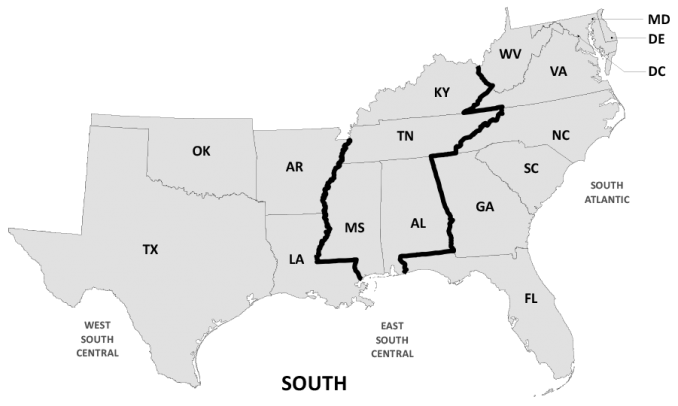
Assemble a list of American writers from the 20th century to today: prizewinners, bestsellers, writers whose works are taught in schools, works that people still read years and decades after publication, and I’m certain that list will contain many Southerners, at least half and likely more. Working off the top of my head and what’s on my bookshelf, I made a list of 48 Southern writers. I’ll wager that Southerners outnumber writers from all other regions in America. There’s a reason for this, and it’s well worth a closer look.
Must be something in the water. That old cliché may explain why New Orleans is such a great place for music, but the South encompasses a big, wide and varied landscape: from Texas in the west, having more landscape variety than some nations with piney woods in the east to desert and mountains in the west to prairie in the north central parts, not to mention the Gulf coast. Following the Gulf through Louisiana, Mississippi, Alabama, and Florida, up the Atlantic coast past Georgia, the Carolinas, Virginia and Maryland. Go inland to the Appalachian mountains in Virginia, West Virginia, Kentucky, Tennessee, North Carolina, Georgia, Alabama, and Mississippi, and then there’s the Ozarks in Arkansas. The South contains a wide variety of landscapes from the Chesapeake Bay, the coastal plains, Texas prairie, the Delta, the Mississippi River, the Appalachian and Ozark mountains. It contains everything from large farms, mountains, coal mining, small dirt farms, swamps, pine forests, hardwood forests, beaches, red clay, coasts, rivers, and more. Can’t be in the water or the soil, too much variety. I think it’s in the blood, and I’ll show you.
What distinguishes this region is a storytelling culture, stronger in some places than others, but the rule of thumb is that Southerners are storytellers. Journalist Rick Bragg noted several times in talks and interviews that his family has the best front-porch-storytellers ever. Many of his books emerged from writing down those stories from northeast Alabama and northwest Georgia. The original settlers in the South were predominately Scots-Irish in the Virginia, Carolina, and Georgia colonies. As America expanded in the early 1800s, those people moved west from the coast to settle Tennessee, Kentucky, Alabama, Mississippi, Arkansas, Louisiana, and Texas, taking their storytelling tradition with them. Beyond the French settlements in Louisiana, some Germans in Texas, and the Spanish influence on Florida, the South didn’t see many immigrants originating from central or southern Europe until the twentieth century. The region is still largely rural and small towns, by no means metropolitan, a visible contrast to regions like the Philadelphia - New York - Boston corridor in the northeast. Storytelling is part of the larger American culture, and while it is certainly present in other regions, I believe it is strongest in the South.
So what does Southern writing look like? What makes the work of a Southern writer different from one out of the northeast or the Pacific coast? The first thing that comes to mind is a greater tendency to have settings close to the land and landscape. Place has a greater importance, and the setting often functions as a character or something having great influence on characters and plot, so that the story could take place nowhere else. Try to imagine A Confederacy of Dunces taking place anywhere but New Orleans or transplanting Lonesome Dove to Connecticut. That’s what I mean. Faulkner’s Mississippi is very distinct, and while maybe you could tweak the stories to move the events to Alabama or Tennessee, there’s no way anybody could imagine these stories taking place in Vermont or Nebraska. The land and climate are all wrong, and more importantly, the people living in those not-Southern places are different in temperament, which points back to culture.
Temperament of the characters in Southern stories comes from another demographic fact: the people often have very deep roots in the land. In parts of Virginia, Georgia, and the Carolinas, many families and communities have been there over 350 years, back to the colonial days. The economy then, and now is likely agricultural, so having land that can be plowed and planted for over three centuries to make a living is a big deal. We don’t see that in New England, where people with roots just as deep worked an economy based more on trade and manufacturing. You can move the blacksmith shop or broker cargo out of another port, but you can’t exactly pick up 20 acres of tobacco or 200 acres of cotton and plunk it down elsewhere. Coal is in that mountain on the edge of town, which can’t go anywhere, and somebody has to dig it out.
Culturally the Midwest is similar to the South in the view of land and agriculture. Midwesterners love the land just as much and hold similar values. The differences I can see is that the Southerners have occupied their acres for 100 to 200 years longer and are better storytellers, more practice. The many German and Scandinavian people who settled the Midwest didn’t come from the same storytelling tradition as the Scots-Irish in the South. Other differences include the more egalitarian culture in the Midwest. The South still has that class structure of the bourbons (landowners, wealthy, educated), the working class, and poor whites and blacks that originated in the colonial era from indentured servants and chattel slaves. The class distinctions are losing their sharpness with the centuries but are still present. Read Rebecca Wells’ Ya-Ya stories or Margaret Mitchell’s Gone with the Wind, then compare them against Larry Brown’s Father and Son or Daniel Woodrell’s Winter’s Bone. The class gaps are bigger in the South, and it shows on the page. Makes for much better conflict and memorable stories, because you need trouble and conflict to craft a good story.
No good Southern writing is complete without a dead mule. I don’t know who first said this, but I do recall an article in Southern Cultures magazine years ago where UNC Chapel Hill scholars surveyed Southern literature to count how many dead mules showed up on the page. I remembered being surprised at how often the trope appeared. This is something you won’t find in stories penned by somebody from Ohio, and I don’t think even Hemingway, the Illinois-born Midwesterner who spent so much time in Michigan, featured any mules among the many dead animals in his writing.
Cultural and societal norms in the South often drive plot and imprint characters, something not always seen in writers outside the South. These do show up in ethnic conclaves like Dennis Lehane’s Boston Irish and Mafia stories that draw on Sicilian culture. Chris Offutt does an excellent job of illustrating Appalachian norms and cultural values in his stories and novels set in eastern Kentucky. His novel, The Good Son centers around the dilemma of the youngest son returning home for his brother’s funeral and how he’s pressed to hunt down and kill the man who murdered his brother as vengeance. Offutt’s short story collection Kentucky Straight displays more of the distinct values and mores of deep Appalachia. You’ll learn why you honk your horn and make some noise when visiting a neighbor unannounced. Carson McCullers’ short story “A Domestic Dilemma” is a heartbreaking tale of a Georgia family relocated to New York by the husband’s transfer to Manhattan. His wife cannot adjust to the cultural differences and turns to drink. Meanwhile, somebody has to raise their two small children. McCullers also shows how tightly blood can tie kinfolk in “The Ballad of the Sad Cafe” with the extremes people will go to for love. Ties between blood relatives seem stronger in the South than elsewhere. Flannery O’Connor is a master of displaying small town values, vanities, and prejudices in her stories. In Winter’s Bone and Tomato Red Daniel Woodrell provides a clear depiction of Ozark values, how people behave and what’s important to them, and these are not the same values people hold to in Philadelphia or Poughkeepsie. Call me biased, but I don’t think any writers from places like Sacramento, Newark, or Detroit could craft stories that catch my attention like these.
Not all of these Southern writers made their careers in the South. Carson McCullers moved to New York, and pretty much stayed in the area the rest of her life, visiting but not returning to Georgia. Harper Lee’s, Tennessee Williams’ and Truman Capote’s careers took them all over the country. Dorothy Allison settled in California, and Faulkner spent a lot of time in California as well, writing scripts for Warner Brothers. He did eventually get permission from his boss to work from home. While the boss thought he meant his apartment in Hollywood, Faulkner took the next train to Oxford, Mississippi and stayed there. Others like Lewis Grizzard and Rick Bragg ventured out of the South for career reasons as newspaper journalists and found a way back as soon as possible. In If I Ever Get Back to Georgia, I’m Gonna Nail my Feet to the Ground Lewis Grizzard described his three years at the Chicago Tribune as being a prisoner of war.
There’s plenty of exceptional writing coming from parts outside of the South, John Steinbeck and Ernest Hemingway coming to mind right away, both Nobel laureates, hailing from California and the Midwest. Others like New England’s Russel Banks, who should have won a Nobel, and then masters like Joyce Carol Oates, John Irving, and Richard Russo, who hail from upstate New York. My thesis is that if you lined up the 100 best American writers and took a roll call, over 50 would be Southerners.
Southern Living magazine compiled a list of 39 contemporary Southern writers in March 2023, new voices worth listening to, and it’s worth a look: www.southernliving.com/culture/contemporary-southern-writers. Below is my alphabetic list of 48 Southern writers. It started at 40 but grew as others came to mind. This is by no means exhaustive, and I’m sure I left out a number of names, like the historian Shelby Foote. Take a look, and better yet take this list to the library, Amazon, or Goodreads to see what you can find. For those not already big fans of Southern authors, you might be in for a treat.
James Agee, Dorothy Allison, Maya Angelou, Pinckney Benedict,
Rick Bragg, Larry Brown, Erskine Caldwell, Truman Capote,
Kate Chopin, Pat Conroy, S.A. Cosby, Harry Crewes,
James Dickey, William Faulkner, Jessee Hill Ford, Shelby Foote,
Connie Mae Fowler, Charles Frazier, Ernest J. Gaines, Lewis Grizzard,
Davis Grubb, Barry Hannah, Zora Neale Hurston, Harper Lee,
Margaret Mitchell, Cormac McCarthy, Carson McCullers, Larry McMurtry,
Toni Morrison, Flannery O’Connor, Chris Offutt, Walker Percy,
Donald Ray Pollock, Catherine Anne Porter, Lee Smith, William Styron,
John Kennedy Toole, Anne Tyler, Alice Walker, Robert Penn Warren,
Kent Wascom, Brad Watson, Rebecca Wells, Eudora Welty,
Tennessee Williams, Tom Wolfe, Thomas Wolfe, Daniel Woodrell